

Spin-photon interface for color centers in diamond
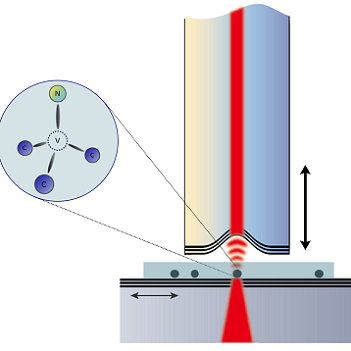
Building a long distance quantum network is one of the big challenges in the field of quantum communication, which requires the development of a quantum repeater. A crucial component of this is an efficient, coherent spin photon interface, and coupling single color centers in diamond to a microcavity is a promising approach therefore. In our experiments, we integrate a diamond membrane to an open access fiber-based Fabry-Perot microcavity [Heupel 2020] to attain emission enhancement into a single well-collectable mode as well as spectral filtering. Simulations predict the feasibility of a strong enhancement of the Zero-Phonon-Line (ZPL) emission efficiency, reaching values of up to 80%. We have performed spatially resolved characterizations of different coupled cavity-membrane devices and observed significant effects of the diamond membrane on the cavity mode properties [Körber et al]. We have also integrated such devices in a cryogenic environment and achieved highest mechanical stability for operation under resonance conditions [Pallmann 2023].
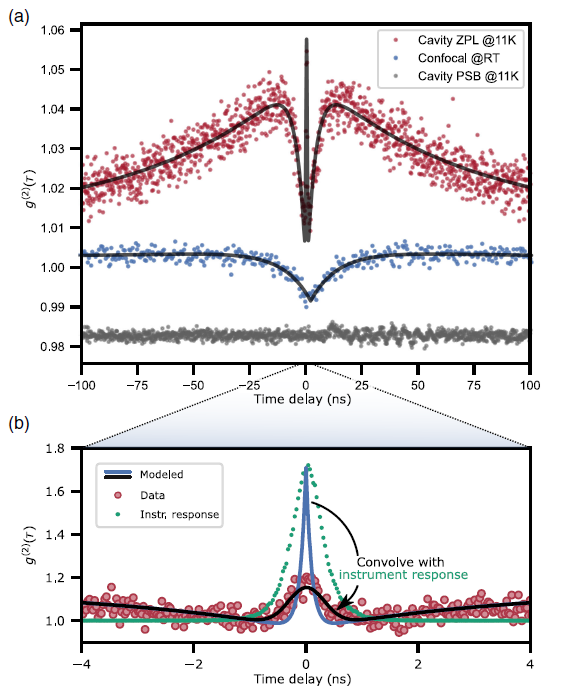
In a first step, we have integrated ensembles of NV centers into the cavity. Under cryogenic conditions, we observe Purcell-enhanced emission, a super-linear increase of emission with increasing excitation power, and marked bunching in the autocorrelation function [Pallmann 2024]. These features only prevail when coupling the zero-photon line (ZPL) to the cavity under cryogenic conditions. The phonon sideband shows a flat g(2) function. In a confocal microscope, where less emitters are spatially selected, antibunching is visible. This experiment shows collective emission of few, incoherent, and spatially separated emitters, evidencing the influence of the common cavity coupling [Qu 2025].
In collaboration with Wolfgang Wernsdorfer and Christoph Becher, we have started to study the SnV center in diamond as a promising alternative. We have observed Fourier-limited and long-term stable optical transitions, long spin lifetime at sub-K temperature, and achieved coherent spin control by straining the diamond as well as by using a superconducting waveguide to avoid heating due to dissipation. This allowed us to observe electron spin coherence of up to 10ms under dynamical decoupling [Karapatzakis 2024].
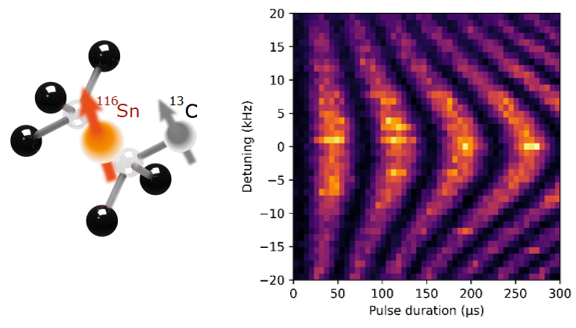
Furthermore, we were able to detect, initialize, and coherently control a neighboring 13C nuclear spin with high fidelity. Using dynamical decoupling, we were able to demonstrate a coherence time above 1 second [Resch 2026].
We are currently working on coupling SnV centers to a fiber cavity to realize an efficient and coherent spin-photon interface.